

Located in the northern part of the Charente department, on the historical border between Poitou and Angoumois, the small village of Longré possesses a quiet history—one that is nonetheless typical of regions in western France.
🏛️ Ancient Origins: Archaeology and Antiquity
The North Charente area is particularly rich in prehistoric remains, notably evidenced by the burial mounds (tumuli) in the neighboring commune of Tusson and the Gallo-Roman structural foundations in Paizay-Naudouin-Embourie.
In Longré itself, the history of early human occupation is reflected in its open-plain landscape:
Prehistory and the Neolithic: Although there are no major megalithic monuments within the commune’s own boundaries, the territory has yielded traces of human presence and flint tools, linked to the intense human activity in the nearby Aume valley.
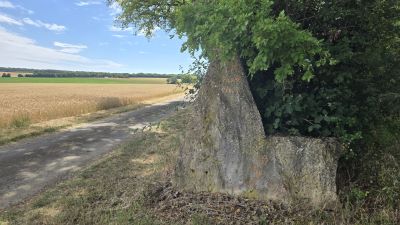
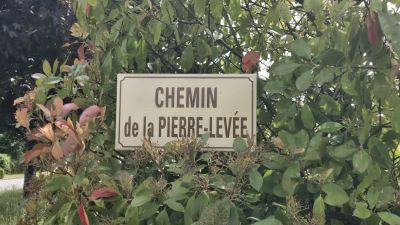
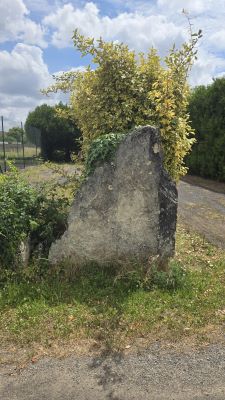
The place name « Pierre Levée » preserves the memory of a megalith that has since been destroyed. The path leading to the sports ground bears this name and is lined with broken stone slabs that may well be its remains.
Other place names, such as La Croix du Tertre, Les Chirons, or Le Chiron Fragné, might point to the former presence of megaliths.
The Gallo-Roman period: The region was crisscrossed by secondary Roman roads and villae (agricultural estates). The proximity of the site at Embourie suggests that the fertile lands of Longré were already being cultivated and exploited during this era, organized into large estates.
⚔️ The Middle Ages:
Lordships and frontier lands
In the Middle Ages, Longré was not home to any major military fortress, as its flat, open terrain was ill-suited for one. Instead, the village’s history centered on small fiefs and seigneurial residences.
The lordship of Longré: The village served as the seat of a minor lordship that was subordinate to the lordship of Londigny. It belonged to the de Lestang (or de Létang) family. In 1469, Henri de Lestang, an esquire, rendered « acknowledgment and homage » (an act of feudal submission) for this fief to Jean Jousserand, the lord of Lairé and Londigny.
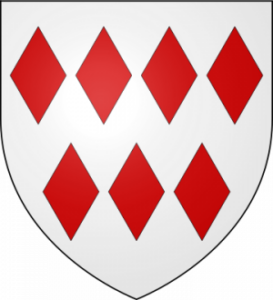
Coat of arms of the de Lestang family
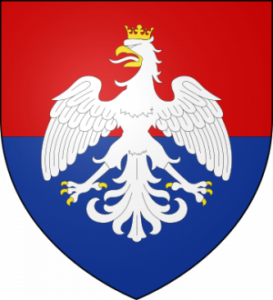
Coat of arms of the de Jousserand family
Le Logis de Cherconnay: This is the commune’s heritage jewel, located in the hamlet of Le Vivier. Built during the 14th and 15th centuries, this fortified medieval residence originally belonged to Ithier Corgnol. It features architecture typical of the late Middle Ages, with an elongated façade and a round, spiral-staircase tower topped by a conical roof—a structure punctuated by arrow slits for defense.
⚜️ From the Ancien Régime to the Revolution:
Local Families
From the 17th to the 18th century, life in Longré was shaped by its small rural estates and its local nobility—comprising both the noblesse de robe (nobility of the robe/magistracy) and the noblesse d’épée (nobility of the sword/military).
The Biargerie and Le Vivier estates: The village was home to several gentilhommières (small manor houses). The de Lestang family maintained a strong influence in the hamlet of Le Vivier until the 18th century; Nicolas de Lestang, Lord of Le Vivier de Longré, died there in 1722. Another notable estate from this period is the logis (manor house) of La Biargerie, which served as a significant agricultural and bourgeois holding as early as the 17th century.
The era of the Brumeaud and Duge de Bernonville families: In 1654, the Cherconnay estate passed into the hands of the Brumeaud de Moulinneuf family, and subsequently to the Duge de Bernonville family in 1766, following a marriage. The latter held the estate for more than a century and a half (until 1928).
The French Revolution (1789): The transition brought about by the Revolution took place relatively calmly in Longré. The lord of the time relinquished his noble title without any major conflict and integrated into the new administrative structure. In fact, he was among the notable figures selected in March 1790—within the parish church—to help organize the affairs of the newly established commune.
🚜 Contemporary era and recent history
The 19th and 20th centuries were marked by Longré’s deeply agricultural character and by the transformations taking place within the rural world of the Charente region.
Division of property (1796): In 1796, shortly after the Revolution, the large Cherconnay estate was split into two separate properties—a reflection of the fragmentation of former seigneurial estates, which were increasingly acquired by the rural bourgeoisie or large-scale farmers.
The agricultural golden age and the decline of the vineyards: Like the entire Ruffécois region, Longré benefited from cereal cultivation and, for a time, from vineyards used for Cognac production (within the « Fins Bois » zone). However, the phylloxera crisis in the late 19th century dealt a severe blow to the local economy, forcing a shift toward mixed farming and livestock rearing.
A former grain storehouse, near the Pechebrun flour mill, bears witness to the grain-related activity in the commune. (on the left, the main structure of an old mill north of Longré; on the right, a postcard of the Pechebrun flour mill)
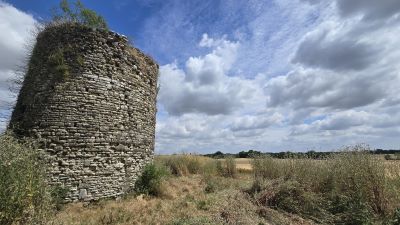
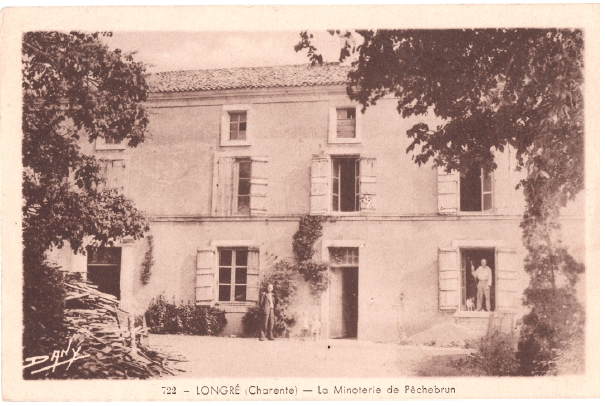
Modernization and heritage preservation: Following the Second World War, the village experienced rural exodus, yet also began to develop an awareness of the value of its historical heritage. Several old outbuildings—including a square tower at Cherconnay—were unfortunately demolished in the post-war period; however, the main structure of the Logis de Cherconnay was preserved and subsequently designated as a Historic Monument in 1991 and 1994, ensuring its safeguarding and restoration.
📚 References and Sources
Historical Works and Bulletins
Dolmens, menhirs, tumulus et pierres à légende en Charente [Dolmens, Menhirs, Tumuli, and Legendary Stones in Charente] by Jean-Sébastien Pourtaud (Les Indes Savantes, 2021).
Société Archéologique et Historique de la Charente [Archaeological and Historical Society of Charente]: Their periodic bulletins contain numerous accounts regarding noble families from the Ruffec area (the Corgnol, de Lestang, and Jousserand families).
Bulletin de la Société charentaise des études locales [Bulletin of the Charente Society for Local Studies] (notably the July 1937 issue, which contains a comprehensive monograph on the families of Longré in the 18th century, written by the schoolteacher Ricochom).
La Charente d’antan [Charente in Times Past] by Pamela de Montleau and Jacques Baudet (Éditions HC, 2024).
Web Resources and Databases
Monumentum / Base Mérimée: Architecture and official history of the Logis de Cherconnay (manor house) via Monumentum: https://monumentum.fr/monument-historique/pa00104561/longre-logis-de-cherconnay
Musée du Patrimoine de France [Museum of French Heritage]: A chronological breakdown of the lords of Longré and the architectural evolution of the commune: https://museedupatrimoine.fr/logis-de-cherconnay-a-longre-charente/9304.html
Archives départementales de la Charente [Departmental Archives of Charente]: Consult the parish registers of Longré and the aveux (formal declarations of land tenure) for the lordship of Londigny.